Everything you need to know about the regulations for battery charging rooms and the hydrogen risk
To assist in the handling or transfer of heavy loads in factories or warehouses, handling equipment is commonly used: forklift trucks, pallet trucks.... These devices are usually powered by lithium-ion or lead batteries. It is during the charge of the battery that the latter are likely to release hydrogen, which mixed with the ambient atmosphere can create an explosive atmosphere.
To reduce this risk, it is important to understand when and how to apply the regulations in force in charging rooms.
What is a load room and when should you have a dedicated room?

When you own a handling equipment, whether it is an electric forklift, an electric stacker or an electric pallet truck, the question of battery charging arises and therefore a charging room dedicated to battery charging. The regulations in force clearly indicate whether a dedicated room is required or not.
It is important to distinguish between the different regulations in force since there are two types of battery technology: lead-acid and lithium ion.
- The Order of May 29, 2000 (Decree of May 31, 2006) relating to lead-acid batteries, which indicates that a charging room is required when the charger power exceeds 50kW of direct current power.
- Decree No. 2019-1096 of October 28, 2019, relating to Lithium-ion batteries, which indicates that a charging room is required when the charging power exceeds 600kW of DC power.
In conclusion, in order to know if the charging room regulations apply, it is necessary to add up all the powers of the battery chargers present within the establishment.
Hydrogen risk in load rooms

Now that we know when it is necessary to have a charge room, we will focus more specifically on lead-acid batteries. Indeed, the technology used in these batteries (lead plate in sulfuric acid) can generate hydrogen by chemical reaction between lead and acid. This possible hydrogen emission is mainly due to a failure of the battery casing.
What is the hydrogen risk?
Hydrogen is an extremely flammable gas. It can ignite in contact with air and in the presence of an ignition source or in contact with oxidizers. Also very explosive, the explosion danger zone is located when the hydrogen concentration is between 4% vol/air and 75% vol/air.
As a reminder, the LEL (Lower Explosive Limit) of hydrogen is 4% volume/air, very close to the LEL of methane or town gas. However, hydrogen requires 10 times less activation energy than methane to ignite and therefore potentially explode. This makes it a very dangerous gas and therefore subject to declaration for this type of application in load rooms.

The evolution of the regulation of lead-acid batteries
The lead battery charging premises are subject to regulations relating to the decree of 29 May 2000 for installations classified for environmental protection (ICPE). These installations are subject to declaration (heading n°2925) for a cumulative charging power equal to or greater than 10kW.
This threshold was changed by decree in 2006 from 10 kW to 50 kW. From now on, any company with battery-powered forklifts and whose cumulative charging power is equal to or greater than 50 kW, will have to dedicate a room for recharging the batteries of its forklifts, in order to comply with the regulations.
The main obligations that the load room standard imposes:
The regulation imposes a certain number of equipments within a charging room, hereafter a non exhaustive list to give you an overview:
- Ventilation in order not to exceed 1% of hydrogen concentration in relation to the volume of the room
- Waterproof lining
- IP 551 lighting
- Chargers stop in case of mechanical ventilation failure
- Acid retention tank
- Fire extinguishers
- Fire door
- Emergency exit
Safety and good practices in relation to hydrogen risk

In case your load power is equal or superior to 50kW, the regulation imposes a good ventilation in order not to exceed 1% of hydrogen concentration in relation to the room volume.
But how do you know if this rule is respected?
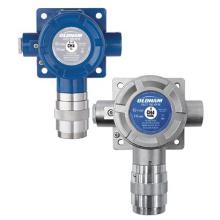
You must be able to measure the hydrogen concentration and thus generate a necessary and sufficient air renewal to never exceed 25% of the LEL of hydrogen, i.e. 1%vol/air. This measurement of the hydrogen concentration is done with the help of catalytic gas detectors.
For the installation of gas detectors, the good practices are listed in the INRS technical aid 6120, in summary:
- Hydrogen is a light gas. It is recommended that they be installed high above the batteries under load.
- Take into account the architecture of the roof of the charging room where gas pockets could be created if beams of 20-30cm are present.
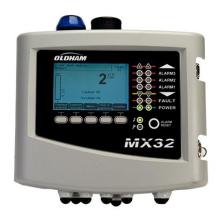
- The sensors will be connected to a gas detection unit. The central detection unit will be positioned outside the room and will generate an alarm for the evacuation of the personnel at 10% of the LEL, i.e. 0.4%vol/air, and at 25% of the LEL, an alarm for the safety of the room.
- This detection can be coupled with a 2 speed ATEX ventilation. The first speed is permanent to bring fresh air into the room, the second speed is controlled by the 25% LEL hydrogen alarm, to dilute and therefore lower the hydrogen concentration.
- If this threshold is exceeded, it is necessary to set up slaves to cut off the energy for charging the batteries.
Our technical solutions
As a specialist in gas risks and an approved partner of the biggest brands (Oldham, Honeywell, Dräger), do not hesitate to contact us to help you define your needs. We will provide you with the most suitable turnkey solution.