


CATEC® or confined space training: the differences
A confined space is a potentially dangerous place, as its atmosphere cannot be easily renewed. To understand these risks, training courses are available to help you acquire the knowledge you need to ensure your safety.
In particular, there is a certification course designed for all those working in the water and wastewater sector : CATEC®.
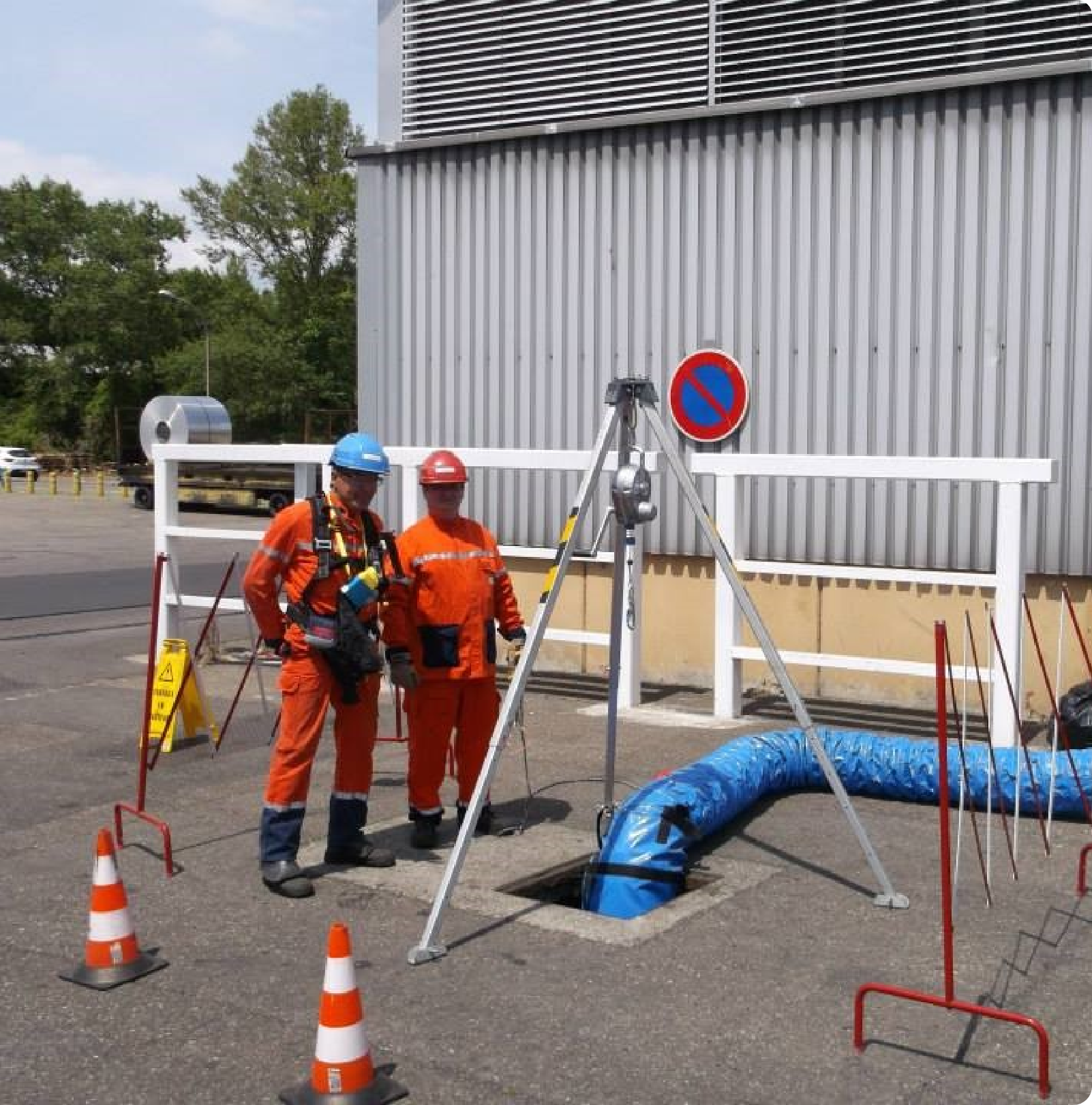
The CATEC® procedure
There is a skills certification procedure: Certificat d'Aptitude au Travail en Espace Confiné or CATEC®. It describes a common, homogeneous set of skills, incorporating best practices for preventing health risks during operations.
- Who is it for ? All employees working in confined spaces in the production and distribution of drinking water, and the collection and treatment of wastewater. Their day-to-day work involves inspecting, servicing, repairing, maintaining and developing these installations.
- When ? Recommendation R-472 of November 19, 2012 by the Comité Technique National des industries du transport, de l'eau, du gaz, de l'électricité, du livre et de la communication in addition to R447.
- What is CATEC® training ? CATEC® training is a risk-specific certification procedure in addition to basic safety training for all those involved in working in confined spaces (totally or partially enclosed areas).
It is advisable to train all those involved in such work, from personnel entering the space to supervisory staff (outside supervisors). The certificate is valid for 3 years.
Prerequisites for obtaining CATEC® certification :
All
- Medical fitness
- Notions of markup
- Mastering the use of gas detectors
Supervisors
- Evacuation breathing apparatus (for checking against the worker's equipment at the time of intervention)
- Use of work at height equipment: tripods, fall arresters, harnesses (check against the worker's equipment at the time of work).
Speakers
- Medical fitness to work in confined spaces, to work at heights, to wear emergency respiratory protection equipment
- Proficiency in the use of work equipment at height (fall arresters: harnesses, tripods, etc.)
- Mastery of PPE use (including self-rescue mask)
It is the employer's responsibility to train his employees in the use of the equipment made available to them. This training is given prior to CATEC® training.
Training in confined spaces
Confined-space training enables you to acquire and/or reinforce the knowledge you need to ensure your own safety, and that of others involved. Outside the water and wastewater sector, confined spaces can be found in many other activities, including :
- Agricultural sector (slurry pits, silos, etc.)
- Agri-food (winemaking vats, cellars, slaughter waste recovery tanks, cold rooms, etc.)
- Chemicals (reactors, mixing and storage tanks, etc.)
- Water and sanitation (treatment, storage and supply of drinking water)
- Waste (collection, storage, sorting, etc.)
- Transportation (ships, tanks, underground public transport networks, etc.)
- Real estate (crawl spaces, equipment rooms, sewage treatment plants, etc.)
- Construction (concrete mixers...)
In general, training is divided into two parts: a theoretical part and a practical part involving real-life situations. At the end of the course, trainees are able to :
- Analyze the intervention environment
- Prepare and organize their intervention
- Secure the intervention zone
- Operate safely in confined spaces
- Implement emergency measures in the event of an accident
Initial training is not enough on its own, and must be regularly refreshed to ensure that operators are comfortable with the risks associated with confined spaces.
This training course is also aimed at companies, to make them aware of the fatal accidents and disabilities that can occur during operations in confined spaces, and of their obligations in terms of health and safety in the workplace: prevention plan, single document, criminal liability, etc.
What equipment is recommended ?
In addition to training, protective equipment is available to counter the various risks:
- Asphyxiation risks Asphyxiation : use of fans/extractors, gas detectors for atmosphere control, wearing of PPE (self-rescue masks).
- Risk of falling from heights : Use of fall-arrest devices such as harnesses
- Risk of injury : Periodic inspection of your equipment
Recommended items
Preventing the risks associated with working alone
Risks related to work in confined spaces

Confined spaces : risks and prevention


